Free AI visibility checker
Does ChatGPT recommend you?
Enter your domain. We'll ask ChatGPT what your buyers ask, and show you who it names.
Free. No signup for your first check. Five buyer questions, asked live on ChatGPT, about 30 seconds. Updated August 23, 2026.
How the check works
- 01
We read your homepage
Enough to know what you sell and who you sell it to. No crawl, no account, no tag to install.
- 02
We write the questions your buyers ask
Category questions — "what are the best X" — not questions about your brand. Asking a model about a brand you named proves nothing; the test is whether it reaches for you unprompted.
- 03
We ask ChatGPT, with live web search
The same path a buyer takes. We read the answer for which products it recommends and which sources it cites.
- 04
You see who got named
Your hit rate across those answers, and the brands that took the slots you missed.
What's in your report
One number up top, then everything behind it. Nothing is gated inside the result: the questions, the brands and the caveats are all on the page you get.
- Your hit rate
- How many of the five buyer questions ChatGPT answered with your brand in it — shown as "named in 2 of 5", because that is what it is.
- The five questions we asked
- Category questions generated from your homepage ("what are the best X for Y"), each marked Named or Not named. You can reuse them as your own tracking set.
- Who was named instead
- For every question you missed, the brands ChatGPT recommended in your place; for every question you were in, the brands named alongside you.
- The brands ChatGPT names most
- Across all five answers, which competitors appeared most often and in how many answers — the consideration set you are competing for.
- Which of your pages were cited
- When ChatGPT did name you, the URLs on your site it pointed to, so you know which page is doing the work.
- Caveats
- Anything that makes the result less reliable — a homepage we could not read well, a category we had to guess — stated on the result rather than hidden.
How the AI visibility score works
There is no weighting and no secret formula. The score is a hit rate: the number of buyer questions whose answer named your brand, out of the five we asked. Named in two answers is “2 of 5”. We show it that way rather than as “40%” because five questions asked once is a sample, and a percentage would make it sound more precise than it is.
A question counts as a hit only when ChatGPT names you unprompted in its answer to a category question. Being mentioned when someone asks about you by name does not count — that measures whether the model has heard of you, not whether it would recommend you.
What's a good AI visibility score?
Lower than most people expect. Ahrefs found 26% of brands have no AI Overview mentions at all, and in Semrush's 50,000-brand study only 21% of categories had a settled leader. Against that baseline, the bands below are a fair reading of a single run:
| Result | Reads as | What it usually means |
|---|---|---|
| 0 of 5 | Not in the conversation | ChatGPT answered every category question without you. The sources it reads do not mention you, or describe you inconsistently. |
| 1 of 5 | A foothold | You are known for one angle. Typical for a young brand with a couple of listicle or directory placements. |
| 2–3 of 5 | A regular option | You appear where your positioning is clear. The next gain comes from the questions you still miss. |
| 4–5 of 5 | Category default | You are named almost every time. The job becomes holding the position and watching who is rising. |
Two caveats keep this honest. Answers vary between runs, so a brand at 1 of 5 today may be 0 or 2 tomorrow — the trend across repeated runs is the real number. And a score is only as good as the questions: five is enough to show whether you are in the conversation, not enough to rank you against every rival.
How to check your AI visibility for free (3 ways)
1. Run this checker
Fastest. Thirty seconds, no signup, and you get the five questions back so you can reuse them. Limits: one engine, one run. Use it for the starting position, then pick one of the next two for tracking.
2. Ask the assistants yourself, and log it
Write the five to ten questions a buyer would ask before choosing something in your category (“best X for small teams”, “X vs Y”, “cheapest X that does Z”). Ask each one in ChatGPT, Claude and Google with AI Overviews, in a fresh session so earlier answers do not leak in. Keep a sheet with one row per question and one column per engine; record every brand named and, where the answer cites sources, the domains. Repeat monthly. It takes an hour and it is the same data the paid tools collect — slower, but free.
3. Watch AI referrals in Google Analytics
Being named is one thing; being clicked is another. In GA4, filter session source with a regex such as
chatgpt\.com|perplexity\.ai|gemini\.google\.com|copilot\.microsoft\.com|claude\.aiand save it as a segment. Seer Interactive measured AI referral visits converting at 15.9% against 1.76% for organic search (October 2024–April 2025), so even a small line on that chart is worth watching.
How to improve your AI visibility
The number is decided mostly off your own site, which is why publishing more pages rarely moves it. Five things that do:
- 01
Get into the sources ChatGPT already cites
Roundups, comparison pages, directories and community threads in your category. Ahrefs’ 75,000-brand study found Reddit was the single most-cited domain in ChatGPT answers and that "best of" lists account for roughly 44% of citations.
How to get mentioned in ChatGPT → - 02
Make your own pages quotable
Open each page with a direct answer. Search Engine Land’s audit of ChatGPT-cited pages found 72.4% start with a short, link-free answer capsule.
How ChatGPT picks its sources → - 03
Describe yourself the same way everywhere
Homepage, LinkedIn, G2, Crunchbase, Product Hunt and every directory should give the same category, audience and one-line description. Inconsistent entity data is the commonest reason a known brand goes unnamed.
The levers of generative engine optimization → - 04
Let the crawlers in and get indexed by Bing
ChatGPT’s live answers are retrieved through Bing’s index and fetched by OAI-SearchBot. Otterly found 73% of sites block at least one AI crawler, often by accident.
The crawler checklist → - 05
Re-run the same questions after every change
Ahrefs found 38% of pages cited in AI Overviews rank in Google's top 10, down from 76% a year earlier, so the work still compounds but the overlap is shrinking — only a repeated prompt set tells you which change moved which engine.
AI visibility tracking in Sightivo →
Why this is worth knowing
A search results page has ten organic slots and a scroll. An AI answer has about three names and no scroll. When a buyer asks ChatGPT for the best tool in your category, either you are one of those names or you are not in the conversation at all — and unlike a ranking, there is no page two to creep up from. Ahrefs measured the top-ranking page losing 58% of its clicks where an AI Overview appears; Pew found people click a traditional result on about 8% of searches that show an AI summary, against 15% without one.
The uncomfortable part is that this is largely decided somewhere other than your website. These models answer from the roundups, comparison pages, directories and community threads they have read about your category. Being excellent and invisible in those sources looks exactly like not existing.
So the number this tool gives you is not a score to optimise. It is a starting position — and the useful next question is which sources are shaping the answers you are missing from. We wrote up how that works.
AI visibility checker FAQ
- Is there a tool that can check my AI visibility score?
- Yes — this page is one. Enter your domain and the checker asks ChatGPT five buying questions for your category, then reports how many of the five answers named you (your hit rate) and which brands were named instead. It is free and needs no signup for the first check. Paid tools such as Sightivo, Profound, Peec and Semrush’s AI Visibility Toolkit do the same thing on a schedule, across more engines, with more prompts.
- How to see AI visibility?
- Three ways. Run a checker like this one; ask the assistants your buyers’ questions yourself and log which brands each answer names; or look at referral traffic from chatgpt.com, perplexity.ai, gemini.google.com, copilot.microsoft.com and claude.ai in Google Analytics. The first two show whether you are named; the third shows whether it is sending anyone to you.
- How to check AI search visibility for free?
- Use the checker above (first run free, no email), or do it by hand: write the five to ten questions a buyer in your category would ask, put each one to ChatGPT, Claude and Google’s AI Overviews, and record which brands come up. A spreadsheet with one row per question and one column per engine is enough to start. The section below walks through both.
- What is a good AI visibility score?
- The honest baseline is low. Ahrefs found 26% of brands have no AI Overview mentions at all, and Semrush's 50,000-brand study found the most-cited domain was also the most-mentioned brand in only 21% of categories — so being named in even one of five category questions already puts you ahead of many brands. Roughly: 0 of 5 means you are not in the consideration set; 1 of 5 is a foothold; 2–3 of 5 means you are a regular option; 4–5 of 5 means you are the category default. Treat one run as a starting position, not a grade — answers vary between runs.
- Which engines does the checker cover?
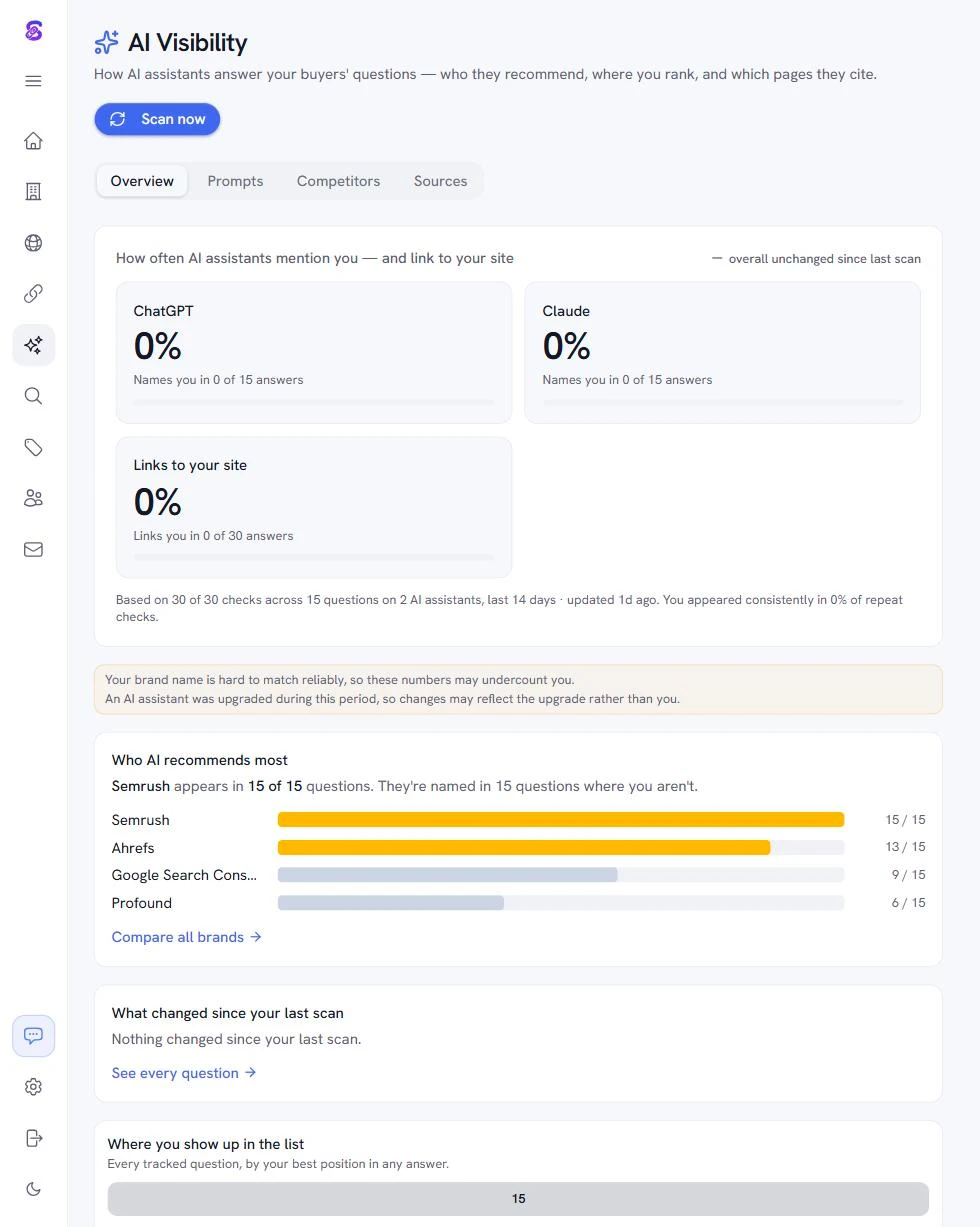
- The free checker asks ChatGPT, with live web search, because it is the assistant buyers use most. It does not check Claude, Gemini, Perplexity or Google AI Overviews. A free Sightivo account tracks ChatGPT, Claude and Google AI Overviews on the same prompt set, on a schedule.
- What does the free AI visibility checker actually do?
- It reads your homepage to work out what you sell, generates the buying questions someone in your category would ask, then puts those questions to ChatGPT with live web search — the same way a real buyer would. It reports how many of those answers named your brand, and which brands were named instead.
- Is it really free?
- Your first check needs no signup and no email. A second check asks for an email, because every run costs us real money in AI usage. There is no trial clock and no card.
- How accurate is one check?
- It is a spot check, not a measurement. Each question is asked once, on one engine. AI answers vary between runs, so a single result tells you roughly where you stand — it does not tell you whether you moved. Tracking that properly needs the same questions asked repeatedly over time.
- How do I get ChatGPT to mention my brand?
- Broadly: be present and described consistently in the sources these models actually read — the roundups, directories, comparison pages and community threads in your category — and make your own pages easy to quote. Your own website is the smaller half of it, which is why writing more pages rarely moves this number. Ahrefs’ study of 75,000 brands found branded web mentions correlate with AI visibility about three times more strongly than backlinks do.
- Do you store my domain or my email?
- We store the domain and the result for 24 hours so a shared link does not re-run the check, and we keep an email if you give us one for a second run. We do not add you to a mailing list from this tool.